
Paraxanthine vs Caffeine: The New Edge for Hard Training and Big Days on the Bike
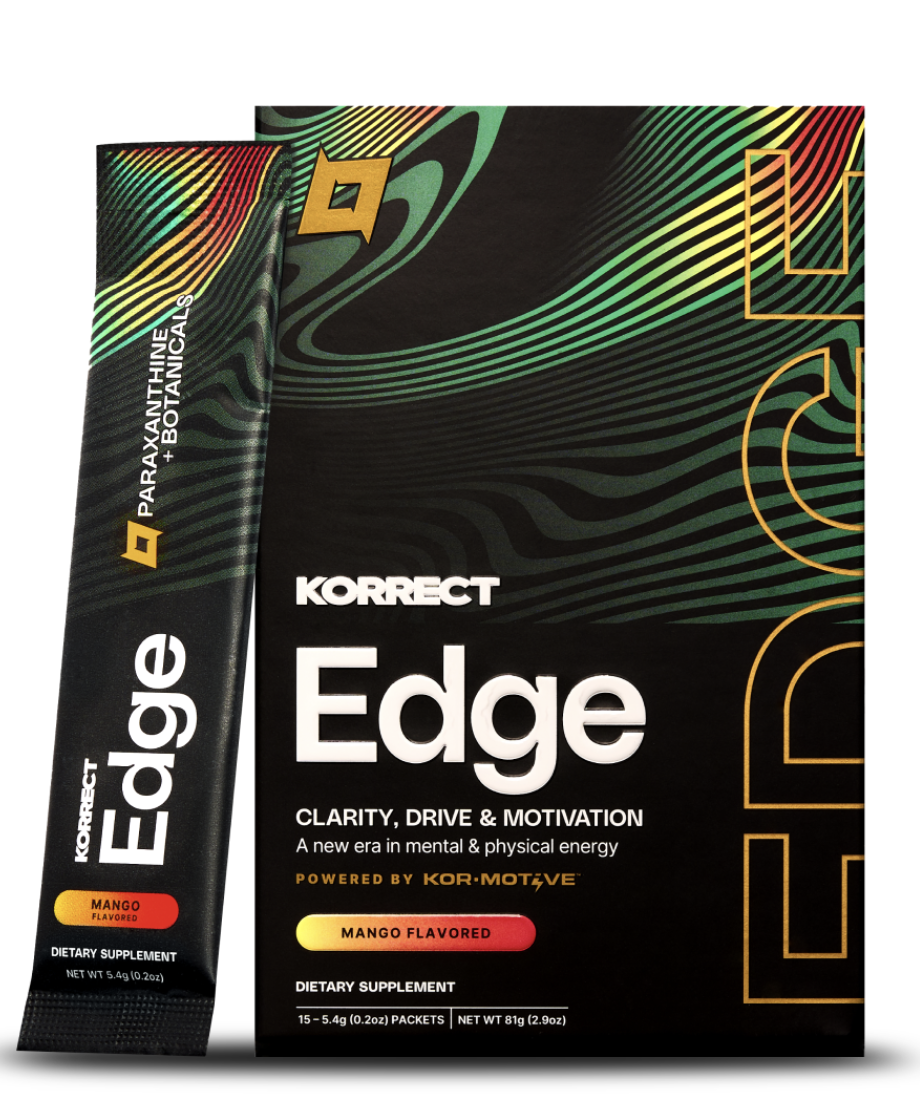
For decades, caffeine has been the endurance athlete’s favorite legal performance enhancer.
Coffee before the ride. Espresso before the race. Caffeinated gels late in the event. The reason is simple: caffeine works. It improves alertness, reduces perceived effort, and has one of the deepest bodies of evidence of any supplement in sport. The International Society of Sports Nutrition states that caffeine consistently improves exercise performance, especially aerobic endurance, commonly in the range of 3–6 mg/kg body mass.
But there is a catch.
Caffeine can also come with baggage: jitters, anxiety, stomach issues, elevated heart rate, trouble sleeping, and that wired-but-not-always-focused feeling. Some athletes feel amazing on caffeine. Others feel overstimulated, scattered, or crushed later in the day. That is where paraxanthine gets interesting.
I have been experimenting with Korrect Edge, which uses a blend built around enfinity® paraxanthine, plus Zynamite® and enXtra™. I am loving it.
It feels like clean focus without the jagged edge I sometimes associate with caffeine. There’s no crash. I can consume this at 13:00 (1:00PM) and have no effects on my sleep! This is HUGE for me.
The big question is whether that feeling is just supplement hype, or whether there is a real physiological reason paraxanthine might feel different.
The answer is: probably both. There is real science here. There is also marketing language that needs to be interpreted carefully.
What Is Paraxanthine?
Paraxanthine is not some random stimulant invented in a lab. It is actually the main compound your body makes when it metabolizes caffeine.
Caffeine is 1,3,7-trimethylxanthine. Paraxanthine is 1,7-dimethylxanthine. In plain English, paraxanthine is caffeine after your body has removed one methyl group. When you drink coffee, your liver, mainly through the enzyme CYP1A2, breaks caffeine down into several metabolites. The biggest one is paraxanthine.
So when a product gives you paraxanthine directly, the idea is that you are skipping part of caffeine’s metabolic process and going straight to one of its most important active metabolites.
That is why paraxanthine is sometimes marketed as “what caffeine becomes.” That phrase is mostly fair. But I would be careful with claims like “all the benefits of caffeine without the downsides.” That is too strong. Paraxanthine is promising, but caffeine has decades of research behind it. Paraxanthine does not yet have that same depth of evidence.
How Is Paraxanthine Different From Caffeine?
Caffeine and paraxanthine are similar in that they both interact with the adenosine system. Adenosine is one of the signals that contributes to sleep pressure and fatigue. When adenosine activity is blocked, you feel more awake and alert.
But paraxanthine may feel different for a few reasons.
First, paraxanthine appears to have a shorter half-life than caffeine. Older pharmacokinetic work reported caffeine’s half-life around 4.1 hours and paraxanthine around 3.1 hours, although individual responses vary. That shorter duration is one reason people are excited about paraxanthine as a cleaner-feeling alternative.
Second, caffeine metabolism varies a lot between people. Some athletes process caffeine quickly and feel great. Others process it slowly and feel wired for way too long. Since paraxanthine is downstream of caffeine, taking it directly may reduce some of that variability. That does not mean it cannot affect sleep or overstimulate you. It can. But it may be less likely to linger compared with caffeine.
Third, paraxanthine may produce more of a “focused energy” sensation rather than the sometimes chaotic alertness of caffeine. This is harder to prove, because subjective feel is not the same as performance data, but it lines up with the way a lot of users describe it.
What Does the Research Say?
The human research on paraxanthine is still early, but it is interesting.
A double-blind, placebo-controlled crossover trial looked at different doses of paraxanthine — 50 mg, 100 mg, and 200 mg — and tested cognitive performance. The study found that paraxanthine improved several measures of cognitive function, with the most consistent effects generally seen around 100–200 mg. The researchers reported improvements in areas like reaction time, attention, vigilance, reasoning, and short-term memory.
That is important because Korrect Edge is built around doses that fall into that meaningful range of 200mg. This is not a “fairy dust” situation where the label contains a microscopic amount of the active ingredient.
There is also newer exercise-related research. One 2024 study looked at paraxanthine, caffeine, and their combination around a 10-kilometer run, then tested cognitive function afterward. The study found that paraxanthine provided greater improvement in post-exercise cognitive function than caffeine after the run.
I have experienced a very similar feeling! After a 4H ride, it takes me less time to get back to work, less time dilly dallying around the house. I’m home, focused,and ready to keep going.
This is also a really interesting result for endurance athletes, because performance is not just about power output. It is also about decision-making under fatigue. Can you still think clearly late in a long ride? Can you hold focus after four hours? Can you fuel, pace, descend, corner, and make tactical choices when the brain starts to fade?
That is where paraxanthine may have a niche. It may not replace caffeine as the most proven endurance supplement, but it could be extremely useful for the mental side of performance.
Why Korrect Edge Is Interesting
Korrect Edge is built around paraxanthine, but it also includes Zynamite® and enXtra™.
Paraxanthine gives the stimulant-like cognitive lift. Zynamite®, a mango leaf extract, is often positioned around mental energy, processing speed, and cognitive performance. enXtra™, from Alpinia galanga, is marketed around sustained alertness and attention. The combination is designed to feel less like a harsh stimulant and more like smooth, directed focus.
That is exactly how I would describe my experience so far: not “amped,” but switched on.
We are trying to train, think, write, analyze data, coach athletes, manage business tasks, and stay productive. Paraxanthine helps!
My Breakthrough Ride on May 9, 2026
The best way I can explain why this product caught my attention is to talk about my ride on May 9, 2026.
That day was a monster for me:
6 hours
190 kilometers (118 miles)
3,322 meters of climbing (10,898 feet)
6,142 kilojoules
394 TSS
0.81 IF for the whole ride
A solid 4 hours at 0.85 IF
Inside that ride, there was serious work: about 1.5 hours of tempo, 40 minutes at threshold, 20 minutes of VO2max, and 13.5 minutes of anaerobic work.
That is not just “I rode long.” That is a deep durability session. That is the kind of ride where physical output and mental organization have to stay online together. You need to fuel. You need to pace climbs. You need to keep pressure on the pedals.
This is where products like Korrect Edge fit beautifully. Not because it magically creates fitness. It does not. The training still has to be there. The carbohydrate intake still has to be there. The durability still has to be earned.
But when fitness is there, better mental energy can help you express it.
On a ride like that, the goal is not to feel cracked, scattered, or overstimulated. The goal is to feel present. Calm. Motivated. Able to keep executing. That is exactly the kind of “edge” I am interested in.
Caffeine Might Still Be Better?
Now, to be fair: caffeine still wins in one huge category.
Evidence.
Caffeine has a massive research base supporting its use for endurance performance, muscular endurance, high-intensity exercise, sprinting, and sport-specific performance. The ISSN position stand concludes that caffeine has consistent performance benefits, especially for aerobic endurance, with common effective dosing around 3–6 mg/kg.
For a race-day ergogenic aid, caffeine might still be the king.
I would not say you need to abandon it. Caffeine before a race or late in a long event can absolutely be the right move.
Caffeine may be better for upcoming events where you already know your ideal dose and timing.
You are using caffeinated gels or cola late in an event and know they work for you.
Paraxanthine may be better when caffeine makes you jittery or anxious, the event ends later in the afternoon, you want focus without feeling overly stimulated, etc.
That distinction matters. This is not about saying caffeine is bad. It is about having another tool.
Will Paraxanthine Affect Sleep?
This is one of the biggest claims around paraxanthine and Korrect Edge: clean energy without the sleep disruption.
I would phrase it more carefully.
Because paraxanthine appears to clear faster than caffeine, it may be less likely to interfere with sleep for some people. That is a major reason it feels exciting. But “will not affect sleep” is too absolute. Any compound that changes alertness, motivation, and mental energy has the potential to affect sleep, especially if you take it late in the day or you are sensitive to stimulants.
My practical rule would be this:
If caffeine after noon hurts your sleep, do not assume paraxanthine at 5 p.m. is automatically safe. Test it. Track it. Pay attention not just to whether you fall asleep, but whether you wake up overnight, whether your sleep feels lighter, and how you feel the next morning.
For me, the exciting possibility is not “take it whenever with zero consequences.” It is more like: this may give you a cleaner and potentially shorter-lasting focus tool than caffeine.
That is still very useful.
What About Safety?
The safety data so far is encouraging, but still smaller than caffeine’s.
A 2023 toxicology paper comparing paraxanthine and caffeine found no evidence of mutagenicity or genotoxicity in the tests performed, and reported a 90-day rat NOAEL of 185 mg/kg body weight for paraxanthine, compared with 150 mg/kg for caffeine. The authors suggested paraxanthine could potentially be a safer alternative to caffeine, though animal toxicology is not the same as decades of human use.
Another safety assessment reported no mortality or toxic effects in 28-day and 90-day repeated-dose studies at tested doses.
So the safety signal looks good. But I would still use common sense. If you are pregnant, have heart rhythm issues, uncontrolled blood pressure, anxiety sensitivity, or are taking medications that interact with stimulants, you should be more cautious and talk with a qualified medical professional.
Final Thoughts
Paraxanthine is one of the more interesting performance compounds I have tried recently. It is not a substitute for fitness, sleep, fueling, or consistency. But it may be a better tool than caffeine for certain situations.
Huge rides have become more manageable, as well as life AFTER the ride, which is why I am excited about Korrect Edge.
After using it and looking into the research, I think it is absolutely worth trying — especially if you are an athlete, coach, entrepreneur, or high-output person who loves caffeine’s benefits but not always caffeine’s side effects.
Use the Korrect Energy Discount code CYCLING on any Korrect Energy products, or use this link to go directly to Korrect Edge and LOCK IN.
My advice: start with one packet on a normal training or work day. Do not first-test it on race day. Pay attention to focus, mood, heart rate, feel, stomach comfort, and sleep that night.
For me, it has earned a spot in the toolbox. Not because it replaces hard work, but because it helps me show up more ready to do it!!