
Ben Healy’s Pro Over/Unders for Normal Humans

↓ The Workout
↓ What’s Happening Physiologically?
↓ Lactate Isn’t the Enemy
↓ Oxidative Reuse: Turning Chaos Into Fuel
↓ Mitochondrial Demand: The Real Limiter
↓ Returning Toward Steady State Under Stress
↓ “Lactate Clearing” vs “Lactate Shuttling”
↓ Why This Helps Amateur Cyclists So Much
↓ How Amateur Cyclists Should Modify It
↓ Progressions and Variations
↓ When to Use This Workout
↓ Final Thoughts
A brutally effective way to train race-specific fitness without needing WorldTour genetics.
Ben Healy has become known for his aggressive racing style. Long attacks. Repeated surges. Relentless pressure. He’s the kind of rider who can launch over a climb, force a split, and then somehow continue riding hard afterward while everyone else is trying to recover.
That ability is not just about having a big FTP.
It’s about recovering while still under pressure.
And that’s exactly what this workout trains.
The Workout
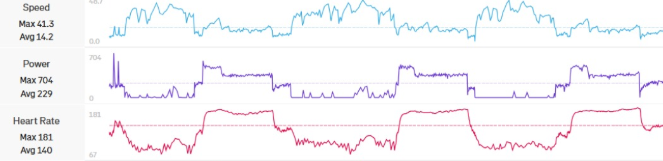
3 x 10 minutes
2 minutes hard (~120% FTP)
8 minutes tempo (85–90% FTP)
~10 minutes recovery between intervals
Simple. Effective.
At first glance, this looks like a pretty straightforward interval session. But the magic is NOT the first two minutes.
The point is what happens afterward.
Can you settle back into strong aerobic riding after flooding the system?
That’s the real skill.
Racing is rarely about producing one hard effort in isolation. Most amateur cyclists can do that. The real separator is whether you can continue riding hard after the surge.
That’s what strong racers do better than everyone else.
What’s Happening Physiologically?
The first two minutes are basically a controlled explosion.
You’re asking the body to rapidly produce energy at a very high rate. That means:
High oxygen demand
Significant glycolytic contribution
Rapid lactate accumulation
Increased ventilation
A huge disturbance to homeostasis
Then comes the important part:
You don’t stop.
You keep riding pretty hard while trying to regain control.
That’s where the adaptations happen.
Lactate Isn’t the Enemy
One of the biggest misconceptions in endurance sports is that lactate is “bad.”
It’s not.
Lactate is actually an incredibly valuable fuel source.
During hard exercise, fast-twitch muscle fibers produce lactate as glycolytic activity increases. But your body doesn’t simply throw that lactate away. Instead, it transports and reuses it throughout the body.
This process is often called lactate shuttling.
Your more aerobic muscle fibers can take lactate in and burn it for energy. The heart can use it. Other tissues can use it. Even the liver can convert portions of it back into glucose through the Cori Cycle.
That’s why elite athletes often aren’t trying to “avoid lactate.”
They’re becoming incredibly efficient at using it.
And this workout directly challenges that system.
Oxidative Reuse: Turning Chaos Into Fuel
Another important concept here is oxidative reuse.
After the hard start, your body attempts to aerobically process the metabolites generated during the surge while you continue producing relatively high power.
In simpler terms:
Your body is trying to turn the chaos into usable energy.
This requires:
Strong mitochondrial function
Efficient oxygen delivery
High aerobic enzyme activity
Good lactate transport capacity
Durable aerobic fibers
This is one reason elite riders can repeatedly attack without completely detonating.
Their aerobic systems are absurdly good at restoring balance while still under stress.
Mitochondrial Demand: The Real Limiter
People often think these sessions are mainly about toughness.
They’re not.
They’re largely about aerobic capability.
After the hard surge, the mitochondria — the aerobic “engines” inside your cells — suddenly have a massive job to do.
They must:
Produce huge amounts of aerobic energy
Help stabilize the metabolic environment
Support continued tempo riding
Process accumulating metabolites
Reduce the reliance on glycolysis
That’s why these workouts often feel uniquely uncomfortable.
You’re essentially asking your aerobic system to clean up the mess while the race is still happening.
Returning Toward Steady State Under Stress
This may be the most race-specific part of the entire workout.
A steady state means your body has stabilized things like:
Oxygen consumption
Breathing
Lactate dynamics
Energy production
But races constantly disrupt steady state.
Attacks.
Corners.
Steep ramps.
Crosswinds.
Bridges.
Positioning fights.
The best racers are not necessarily the riders who avoid those disturbances.
They’re the riders who can regain stability the fastest afterward.
That’s exactly what this session trains.
Your body learns:
“How fast can I calm the chaos down while still pushing hard?”
That’s a massively important racing skill.
“Lactate Clearing” vs “Lactate Shuttling”
Personally, I don’t love pretending these are two entirely separate systems.
They’re happening together.
Yes, some lactate is being processed, transported, reused, and buffered differently depending on intensity and muscle recruitment.
But in practice, your body is constantly managing and utilizing lactate simultaneously.
So rather than obsessing over terminology, focus on the big picture:
You are not teaching your body to avoid lactate.
You are teaching it to USE it.
That’s a much more productive mindset.
Why This Helps Amateur Cyclists So Much
Most amateur cyclists actually have decent steady-state fitness.
What they lack is durability after intensity.
They can produce one hard effort.
But the moment the race gets stochastic — repeated surges, accelerations, attacks, and unstable pacing — they fall apart.
This workout directly targets that weakness.
It improves:
Settling after attacks
Riding threshold under stress
Repeatability
Racing composure
Recovery while moving
Confidence during chaotic race situations
Over time, you stop viewing surges as catastrophic events.
They simply become part of the rhythm of racing.
And psychologically, that changes everything.
How Amateur Cyclists Should Modify It
Most Cat 4 riders should copy the exact Ben Healy version, but if it’s too difficult to execute correctly, make some small tweaks.
2 x 10 minutes
1 minute hard instead of 2
Slightly lower tempo power
Longer recoveries
You want high quality, not complete destruction.
A good sign the workout is appropriately paced:
You can still ride strong in the final interval
Tempo power remains controlled
Cadence stays relatively smooth
Breathing stabilizes during the tempo block
A bad sign:
Total collapse
Power cratering
Needing to soft pedal immediately after the surge
Completely blowing up by interval two
Remember:
The goal is not maximal suffering.
The goal is recovering while still riding hard.
Progressions and Variations
One reason this workout is excellent is how scalable it is.
You can progress it in several ways:
Extend the hard start
Move from:
2 minutes
to3–4 minutes
This significantly increases glycolytic strain and oxygen debt.
Add micro-surges during tempo
Example:
10-second bursts every 2 minutes
Small over-unders
Climb simulations
This adds even more race specificity.
Increase total work
Move from:
3 intervals
to4–5 intervals
Now durability becomes a huge component.
Reduce recovery duration
Instead of 10 minutes easy:
Use 7–8 minutes
Or recover at endurance pace
This increases density and recovery demand.
At higher levels, this becomes incredibly effective because everybody can hurt themselves.
The winners are usually the riders who recover fastest while still going hard.
When to Use This Workout
This session works best during:
Build phases
Pre-race blocks
Race-specific periods
Long rides with structured intervals
Early-season intensity introduction
It can even fit into early base training occasionally if carefully managed.
I especially like placing it:
Before race blocks
In preparation for punchy events
During periods where athletes need “durability under stress”
This is a medium-to-hard session.
Not an every-day session.
Usually once per week is plenty for most riders.
Final Thoughts
If you only train steady power…
racing feels violent.
But if you train transitions —
hard surge → settle → hard surge again —
…you stop panicking when the race explodes.
That’s the real adaptation here.
Not just higher FTP.
Not just more lactate tolerance.
But improved control during chaos.
And honestly, that’s one of the biggest differences between riders who merely survive races and riders who can actually race aggressively.
Simple workout.
Extremely effective.
And absolutely worth trying.